
Sustainability
METRO GROUP views itself as a member of society that contributes to social value creation. As part of its corporate responsibilities, our company strives to create a strong bond between economic goals that extend beyond legal requirements and the needs of society as well as those of customers, employees, investors and partners. We must respect the limits placed on us by the environment. By taking this approach, we act today for the good of tomorrow. In line with METRO GROUP’s sustainability vision “we offer quality of life”, our business activities are designed to create added value while reducing negative effects. This makes all aspects of our business sustainable.
In financial year 2014/15, METRO GROUP once again qualified for a place among the world’s most sustainable retail companies and is listed both in the Dow Jones Sustainability World Index and the Dow Jones Sustainability Europe Index. Moreover, METRO GROUP was named an industry group leader in the category of “Food & Staples Retailing” for the first time in its history. The group’s total score increased to 77 from 71 in financial year 2013/14. This represents a significant improvement for METRO GROUP.
Procurement, production and processing
Social audits of own imports through MGB Hong Kong
and non-food own brands of the METRO GROUP sales lines
as of closing date 30/9
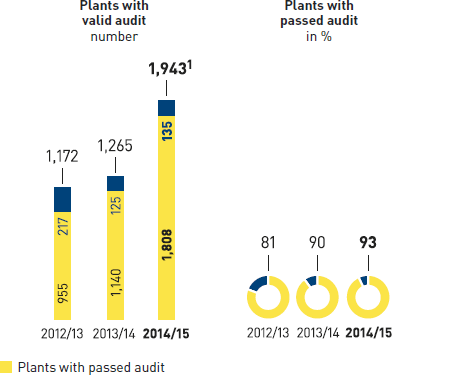
Plants that have passed the audit can demonstrate their successful
compliance with the BSCI standard or an equivalent social standard
system by presenting a certificate awarded by an independent
third party.
1 Adjustment of previous year’s figures for social audits at plants
relating to own imports through MGB Hong Kong. In addition, plants
in relate to non-food own brands of the METRO GROUP sales lines.
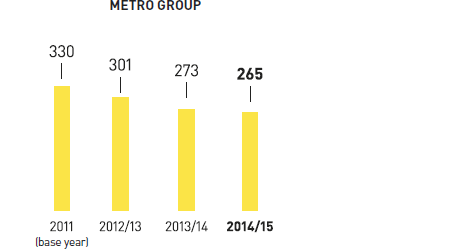
Status climate protection target
greenhouse gas emissions in kg CO₂
(CO₂ equivalent) per m² of selling space
In our procurement activities, we strive to purchase high-quality and safe products with sound social and economic credentials. We do this by defining verifiable quality and sustainability criteria, by monitoring our compliance with these criteria and by supporting our suppliers with training. Our group-wide sustainable procurement policy applies to all product purchases and considers sustainability criteria. It is complemented by regular reviews of our defined standards by independent third parties as well as close collaboration with our suppliers through pooled purchases and regional procurement.
Transport, warehousing and stores
We need energy and natural resources to successfully operate our core business and to meet our customers’ needs. This deployment of resources is reflected in our operating costs and has negative environmental impacts. As a result, we strive to reduce the greenhouse gas emissions of our business operations and our resource consumption. We do this by reducing our energy demand through increased efficiency and a conscious use of energy, responsible management of such resources as our logistics fleet, cooling agents and paper, as well as sustainable property management.
Customers
Our sales lines aim to create added value for their customers. Their products and services must not just meet quality and safety requirements. Consumers also attach increasing importance to sound social and environmental credentials when purchasing goods or services. We want our customers to be sure of these credentials when they shop and implement targeted measures to encourage responsible consumption. We do this by ensuring a high level of transparency along the value chain through traceability and by supporting responsible consumption and improved customer interaction. Measures that contribute to this effort include, among other things, targeted product information and labelling as well as an assortment design with a focus on sustainable, energy-efficient and resource-conserving products.
In financial year 2014/15, METRO Cash & Carry and Real generated sales of nearly €9 million in Germany from fair trade products. That figure includes all articles bearing a Fairtrade or GEPA label. In the same period, our sales lines generated a total of €107 million in Germany-wide sales of products certified in accordance with the EU regulation on organic farming. Our stores also offer products from sustainable, environmentally conscious fisheries. The seal of the Marine Stewardship Council (MSC) communicates this fact to customers. In financial year 2014/15, the sustainable fish product range of our sales lines METRO Cash & Carry and Real in Germany comprised 108 MSC-certified own-brand products and 773 brand items. In addition, those two sales lines distributed fish products bearing the ASC label for sustainable aquaculture as well as the “dolphin-safe” label. In total, sales of approximately €90 million were generated from our portfolio of sustainable fish products in Germany. Real increasingly offers its customers regional products and products from sustainable forestry. The sales line generated sales of nearly €302 million from regional products during the past financial year. Sales of products bearing either the FSC® (Forest Stewardship Council®) or the PEFC (Programme for the Endorsement of Forest Certification) label amounted to just under €22 million. Media-Saturn generated more than €3 billion from energy-efficient electrical appliances.
Disposal
Our commitment to responsible resource management starts at the beginning of the value chain where we verify the origin of the raw materials used in our products and packaging. In the same way, we examine possible approaches to recycling raw materials at the end of a product's useful life or disposing of them in the most environmentally sound manner. To this end, we focus on avoiding waste, reusing and recycling resources and reducing food spoilage.
Social commitment
As a retail company, METRO GROUP has close ties to its local communities. We interact with several million people every day. We also regard our local social and environmental activities as a form of value creation since they help to overcome social challenges. To this end, we foster intercultural dialogue, support our sites and their local communities, and provide targeted help to disadvantaged people, for example, through our support of food bank initiatives as well as donations and local community projects.
For more infomation and key performance, see the Annual Report 2014/15 as well as our website in the section “responsibility”