
Financial management
Principles and objectives of financial activities
The financial management of METRO GROUP ensures the permanent liquidity of the company, reduces financial risks where economically feasible and grants loans to group companies. METRO AG centrally performs and monitors these activities for the group. The objective is to ensure that group companies can cover their funding requirements in a cost-efficient manner and, where possible, via the international capital markets. This applies to operating activities as well as to investments. As a matter of principle, METRO AG bases its selection of financial products on the maturities of the underlying transactions.
Intra-group cash pooling reduces the amount of debt and optimises the money market and capital market investments of METRO GROUP, which has a positive effect on the interest result. Cash pooling allows the surplus liquidity of individual group companies to be used to internally fund other group companies. METRO GROUP’s financial activities are based on a financial budget for the group, which covers all relevant companies and is updated monthly. In addition, METRO AG provides a 14-day liquidity plan.
METRO AG’s current long-term investment grade rating of BBB– and short-term rating of A‑3 by Standard & Poor’s support access to capital markets.
Capital market access is supported by an intensive dialogue with bond investors and credit analysts. Our Creditor Relations team also presents our company to all key European financial markets during its annual roadshow. In addition, investors and analysts can learn about METRO GROUP’s high-performance capabilities in face-to-face meetings and tours.
The following principles apply to all group-wide financial activities:
Financial unity
By presenting a single face to the financial markets, the group obtains better terms on financial markets.
Financial scope
In our relationships with banks and other business partners in the financial arena, we consistently maintain our scope of action in order to remain independent. In the context of our bank policy, limits have been defined to ensure that the group can replace one financing partner with another at any time.
Centralised risk management
We conduct financial transactions to cover our financing requirements and hedge risks related to underlying business transactions. METRO GROUP’s total financial portfolio is centrally controlled by METRO AG.
Centralised risk monitoring
Changes in financial parameters, such as interest rate or exchange rate fluctuations, can impact the financing activities of METRO GROUP. Associated risks are regularly quantified in the context of scenario analyses. Open risk positions – for example, financial transactions without an underlying business transaction – may only be concluded after the Management Board of METRO AG has granted the appropriate approval.
Exclusively authorised contractual partners
METRO GROUP only conducts financial transactions with contractual partners who have been authorised by METRO AG. The creditworthiness of these contractual partners is tracked on a daily basis based on their ratings and the monitoring of their credit risk ratios (essentially credit default swap analyses). On this basis, the Treasury Controlling unit of METRO AG continuously monitors adherence to the authorised limits.
Approval requirement
As a matter of principle, all financial transactions of METRO GROUP companies are conducted with METRO AG. In cases where this is not possible for legal reasons, these transactions are concluded on behalf of the group company or directly between the group company and an external financial partner in coordination with METRO AG.
Audit security
The two-signature principle applies within our company. All processes and responsibilities are laid down in group-wide guidelines. The conclusion of financial transactions is separated from settlement and controlling in organisational terms.
Ratings
Rating development and outlook
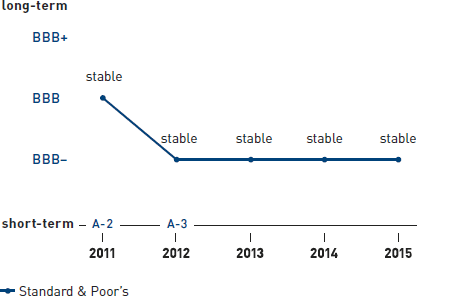
Ratings evaluate the ability of a company to meet its financial obligations. They communicate the creditworthiness of a company to potential debt capital providers. In addition, ratings facilitate access to international capital markets. METRO AG has commissioned Standard & Poor’s – a leading international rating agency – to continuously analyse METRO GROUP’s creditworthiness. In February 2015, METRO AG terminated its rating service contract with Moody’s Investors Service.
The development of METRO GROUP’s long-term and short-term ratings over the past five years is depicted in the graph Rating development and outlook.
The current METRO GROUP rating awarded by Standard & Poor’s is as follows:
| Download XLS (21KB) |
Category |
2015 |
Long-term |
BBB– |
Short-term |
A-3 |
Outlook |
stable |
Based on these ratings, METRO GROUP has access to all financial markets.
Financing measures
The company’s medium-term and long-term financing needs are covered by an ongoing capital market issuance programme with a maximum volume of €6 billion. As early as October 2014, METRO GROUP successfully issued a benchmark bond with a volume of €500 million, a seven-year term and a coupon of 1.375 per cent in the euro capital market to partially refinance its €1 billion bond maturing in March 2015 ahead of time. In addition, a €600 million bond with a term of ten years and a coupon of 1.5 per cent was placed in March 2015.
As of 30 September 2015, a total of €3.6 billion had already been utilised from the ongoing issuance programme.
Short-term financing requirements are covered through the Euro Commercial Paper Programme and a commercial paper programme geared especially to French investors. Both programmes have a maximum volume of €2 billion each. The average amount utilised from both programmes during the reporting period was €1,107 million. As of 30 September 2015, the used volume totalled about €941 million.
In addition, METRO GROUP used bilateral credit facilities totalling €1,189 million as of 30 September 2015. Existing syndicated credit lines totalling €2,525 million were not utilised.
For more information about financing programmes and credit facilities, see the notes to the consolidated financial statements in no. 37 – financial liabilities.
Aside from the established issuance programmes, the group had access to sufficient liquidity via comprehensive, generally multi-year credit facilities at all times. These are listed in the following table.
Unutilised credit facilities of METRO GROUP
| Download XLS (24KB) |
|
30/9/2014 |
30/9/2015 |
||||
|
|
|
||||
|
|
Remaining term |
|
Remaining term |
||
€ million |
Total |
up to 1 year |
over 1 year |
Total |
up to 1 year |
over 1 year |
Bilateral credit facilities |
1,430 |
300 |
1,130 |
1,719 |
962 |
757 |
Utilisation |
−865 |
−260 |
−604 |
−1,189 |
−932 |
−257 |
Unutilised bilateral credit facilities |
565 |
40 |
526 |
530 |
30 |
500 |
Syndicated credit facilities |
2,525 |
0 |
2,525 |
2,525 |
0 |
2,525 |
Utilisation |
0 |
0 |
0 |
0 |
0 |
0 |
Unutilised syndicated credit facilities |
2,525 |
0 |
2,525 |
2,525 |
0 |
2,525 |
Total credit facilities |
3,955 |
300 |
3,655 |
4,244 |
962 |
3,282 |
Total utilisation |
−865 |
−260 |
−604 |
−1,189 |
−932 |
−257 |
Total undrawn credit facilities |
3,090 |
40 |
3,051 |
3,055 |
30 |
3,025 |